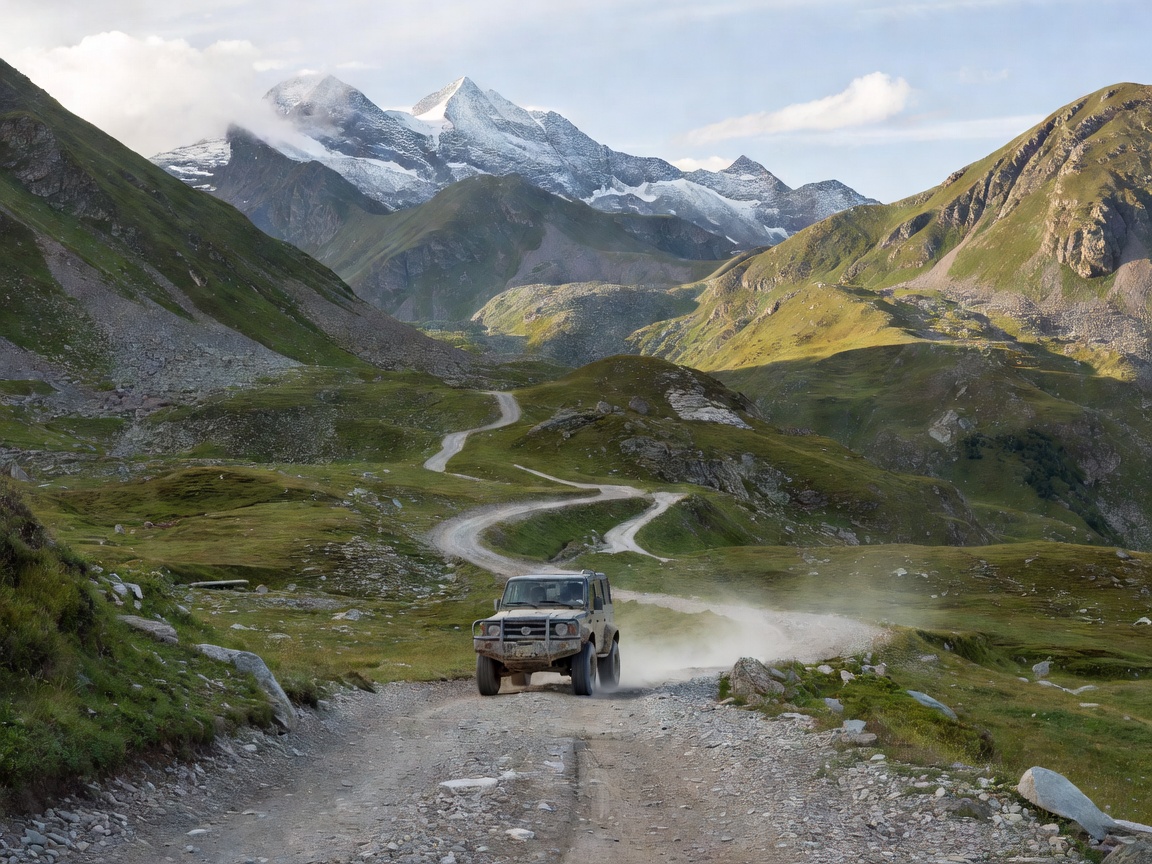
ACCESS / RESPONSIBLE TRAVEL
Off-road travel is not unrestricted travel. In many Alpine areas, motor vehicles are limited to public roads, designated routes or tracks with specific authorization. Rules can differ between countries, regions, municipalities and land managers, and may change with season or conservation needs.
Confirm permission before setting out
Do not use a track simply because it appears on a map, navigation app or social post. A mapped line may be a footpath, cycle route, forestry road, private access or a route closed to motor vehicles. Confirm the vehicle access rules with an appropriate official source, local authority or land manager. Check signs and barriers at the location, and follow any temporary restrictions.
Where access is unclear, choose a verified public road instead. Do not move a barrier, drive around a closure, or rely on another vehicle’s tracks as proof of permission. If local information conflicts, follow the stricter restriction until you can confirm otherwise.
Choose a suitable route and vehicle
Even where access is permitted, match the route to your vehicle dimensions, ground clearance, tires, load and the driver’s experience. A narrow track may not have room to turn around or pass another vehicle. Steep grades, loose surfaces, water, erosion, washouts and low branches can change a route’s difficulty quickly. Check current reports where available and make sure you can return by the same route if conditions deteriorate.
Four-wheel drive can help maintain progress on some surfaces, but it does not create grip, shorten braking distance or make a vehicle immune to damage. Avoid testing limits on a public or shared track. If an obstacle cannot be assessed safely, do not enter it.
Drive lightly and share the route
Stay on the authorized surface. Do not widen a track, cut switchbacks, drive across meadows or enter fragile ground to pass an obstacle. Avoid wheelspin and sudden acceleration that can loosen the surface. Keep noise low, close gates as instructed, and yield carefully to walkers, cyclists, livestock, forestry work and local traffic. Give animals space and follow local guidance around herds and working dogs.
Take rubbish away, use established stopping places and avoid blocking gates, farm access, passing areas or emergency routes. Do not assume that camping, fires, overnight parking or drone use are permitted simply because vehicle access is allowed.
Weather and track condition
Rain, snowmelt and freeze-thaw cycles can make gravel and earth surfaces unstable. Water can hide a soft edge, a deep rut or a damaged crossing. Avoid entering flowing water or an obstacle when its depth, bed or exit cannot be assessed from a safe position. Do not cross a closed bridge or ford. Turn back early rather than damage the track or risk becoming stranded.
Seasonal closures may protect wildlife, reduce erosion or support forestry and farming. Respect them even when the route looks clear. Current local notices take precedence over older guidebooks and downloaded tracks.
Quick access checklist
- Confirm motor-vehicle access with current, suitable local sources.
- Read signs and obey closures, barriers, permits and time limits.
- Check route width, surface, turnaround options and weather exposure.
- Stay on the authorized track and give people, animals and work vehicles priority.
- Carry a legal alternative and turn back if conditions or access are uncertain.
Responsible off-road travel begins with the decision not to drive where permission is uncertain. A public road or a walk from a legal parking area is a better choice than an unauthorized track.